


Bharata’s Final Plea to Rama (Ramayana Series 53)


Having realised that Rama was angered by Jabali’s atheistic arguments, the venerable sage Vashistha addressed him:
“Rama! Jabali, too, understands well the mysteries of birth and death. He spoke in this manner by adopting an atheistic argument only because he wished to persuade you to return to Ayodhya.
“O Lord of the world! Listen as I explain the established order of this world.
“You are the eldest son of King Dasharatha, renowned by the name of Rama. Reflect upon the sacred traditions of your ancestral lineage. In your dynasty, the royal coronation has traditionally been bestowed upon the eldest son; the younger sons have not ordinarily been crowned in his place.
“Among the kings of the Ikshvaku dynasty, it is the eldest son who succeeds to the throne. This is the ancestral dharma of your house. When an eldest son is present, the younger son is not crowned king.
“You should not be the first among the descendants of Raghu to abandon this eternal tradition of your noble lineage. Just as your father, King Dasharatha, governed this vast earth, adorned with incomparable gems and comprising numerous kingdoms, so too must you assume the responsibility of ruling it.”
Although Vashistha had explained the ancestral duty of the royal house and urged Rama to follow it, Rama showed no sign of yielding. The royal preceptor therefore offered him further counsel grounded in dharma:
“O Kakutstha! Every human being born on this earth has three preceptors: the father, the mother, and the spiritual teacher.
“O foremost among men! The parents give birth to a person, while the teacher imparts knowledge. It is for this reason that the teacher is called a guru.
“Rama, as you know, I was the preceptor of your father, and now I am your preceptor as well. If you listen to my counsel and act accordingly, you will certainly not depart from the path followed by the righteous.
“If you govern this assembly of Brahmins, your kinsmen and relatives, these provincial rulers, and all your subjects in accordance with dharma, you will not be violating the righteous path upheld by noble men.
“Nor is it fitting for you to disregard the words of your aged and virtuous mother. Even if you were to obey her wishes and return to Ayodhya as she desires, you would not be abandoning the path of righteousness.
“O Raghava, valiant in the observance of truth and dharma! Bharata stands before you, pleading earnestly. He is as dear to you as your own self. Honour his request. By doing so, you will certainly remain within the path followed by the righteous.”
Having spoken these pleasing and persuasive words, Vashistha settled down.
Then Rama, the noblest among men, replied:
“Revered sir! From the very beginning, parents undertake countless acts of worship, sacred rituals, the recitation of mantras, prayers, vows, and fasts, all in the hope of being blessed with a worthy son.
“How can anyone ever repay the debt owed to parents who endure so much hardship for the sake of having a child? Surely, it is impossible.
“When a child is born, the mother forgets the agony of childbirth in an instant and nurses her baby. Setting aside her own comfort, sleep, and meals, she devotes herself constantly to the child’s care. She feeds the infant, keeps it warm, bathes it, massages its little body, and attends to every need with boundless affection.
“The father, too, carries his son upon his lap day after day. As the child babbles in its innocent speech, the father responds with playful, affectionate words of his own. He embraces the child again and again, brings toys to delight him, and lovingly nurtures him as he grows.
“How, then, could anyone ever fully repay the immeasurable debt owed to such parents?
“Our father, Dasharatha, who gave me life, has already issued his command. Neither his solemn promise nor his command shall now become false—and neither must be allowed to become false.”
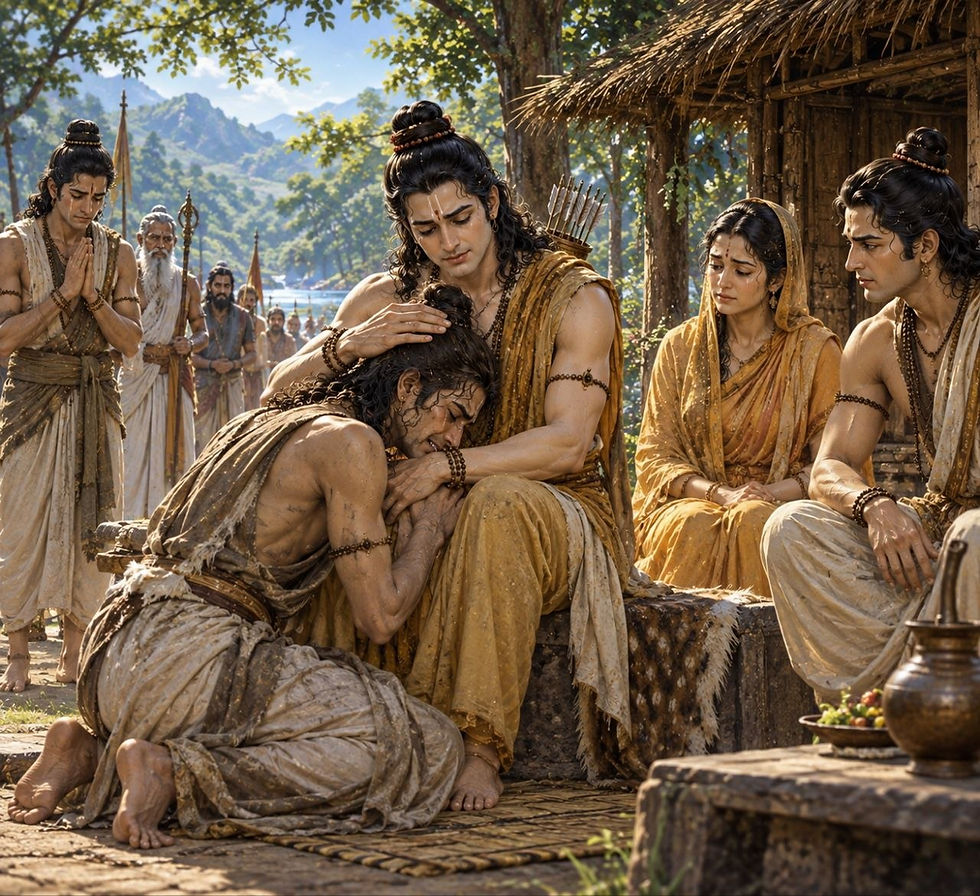
After Rama had spoken thus, Bharata, broad-chested yet overwhelmed by profound sorrow, turned to Sumantra, who stood beside him, and said:
“Sumantra! Go at once and bring a bundle of darbha grass. Spread it upon the ground.
“Until my noble elder brother is pleased with me and grants my earnest request, I shall undertake prāyopaveśa—a fast unto death—in his presence.
“Consider the plight of a Brahmin who lends money in the hope of earning interest but ultimately loses even his principal. Such a man, having received neither his expected gain nor the return of his money, goes without food, covers his face, and lies down at the doorway of the debtor’s house.
“In the same manner, until Rama agrees to return with me to Ayodhya, I shall lie without food upon the darbha grass at the entrance to this forest hermitage.”


Comments