


Rama Hears of Dasharatha’s Death (Ramayana Series 51)

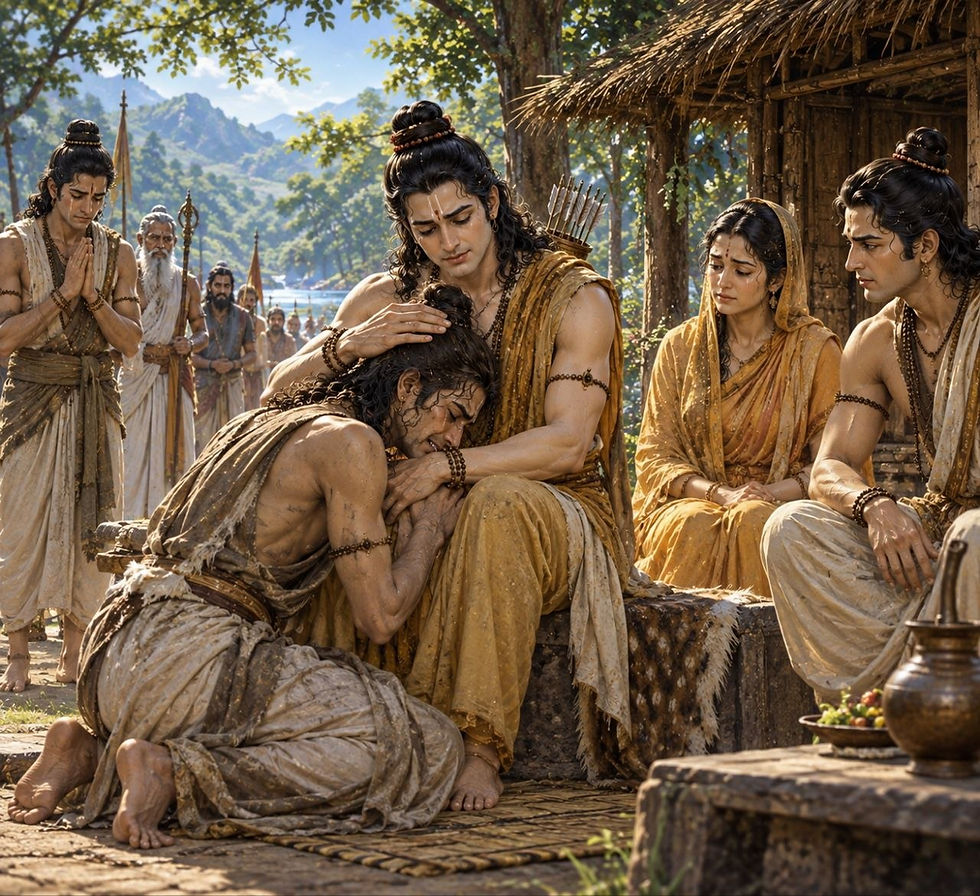
Like the thunderbolt weapon hurled by Indra, the vanquisher of the Danavas in battle, Bharata’s words were harsh, unbearable, and struck the heart like a thunderbolt of speech. Hearing from Bharata the painful news of his father’s death, Rama raised both his arms and collapsed to the ground, just as a tree laden with flowers falls when severed by an axe.

Overcome with grief, the mighty-armed Lord of the earth, wielder of the great bow, lay unconscious upon the ground like an exhausted elephant that, after repeatedly rubbing its trunk and tusks against the bank of a river, finally lies down in weariness. His three younger brothers, along with Vaidehi, surrounded him, weeping bitterly and attending upon him. When cold water was sprinkled upon him, Rama gradually regained consciousness. Tears of sorrow streamed from both his eyes, and he began to speak words filled with deep compassion and grief.
Having heard from Bharata that his righteous father, the lord of the earth, had departed for heaven, the virtuous Rama spoke these words:
“Alas! Now that our father has passed away, what purpose would there be in my returning to Ayodhya? Who will protect the city of Ayodhya now that the illustrious King Dasharatha, the foremost of kings, is no more? Even though I was born as a son to that great soul, I could not be of any use to him. Surely, my very birth has proved futile. The great king who died from the grief of separation from me—I was not even able to perform his final rites.
“O sinless Bharata! You alone have fulfilled your duty. You are truly blessed. Along with Shatrughna, you have performed all the funeral rites for our father. Ayodhya, deprived of King Dasharatha and left without its principal protector, is now disturbed and bereft. Even after completing my fourteen years of exile, I do not wish to enter that city immediately.
“O scorcher of foes! Now that our father has departed from this world, who will instruct me in matters of dharma and adharma when I return to Ayodhya after completing my fourteen years in the forest? He would observe my righteous conduct and obedience to his commands, console me with affection, and speak words so sweet that they delighted my ears. From whom shall I hear such affectionate words hereafter?”
Having spoken thus to Bharata, Rama turned towards his beloved wife, Sita, whose face shone like the full moon, and, overcome with sorrow, said:
“Sita! Your father-in-law has passed away.”
Then, turning towards Lakshmana, he said through tears:
“Lakshmana! You too have become fatherless, dear brother. Bharata has brought us the grievous news that King Dasharatha has departed for heaven.”
At that moment, Sumantra—one who was closely associated with the illustrious Ikshvaku lineage, renowned, immensely wise, straightforward in nature, self-controlled, peaceful, and deeply devoted to Rama—gently consoled the princes with words of wisdom and affection. Taking Rama by the hand, he led him towards the sacred Mandakini River.
Accompanied by Sita and his brothers, the illustrious princes reached the beautiful Mandakini, a sacred river blessed with holy waters. Its banks were surrounded by forests filled with trees that were perpetually adorned with flowers, and its waters flowed with great force. They entered a pure and spotless sacred ford, free from mud, and Rama, together with his brothers, offered water to Dasharatha, saying:
“O Father! May this sacred offering be yours.”
Thus, they performed the water oblation for King Dasharatha.
After offering the water, the radiant Raghava returned with his brothers to the banks of the Mandakini and performed the pindadana—the offering of rice-balls—for his departed father.
Knowing Bharata’s deep affection and reverence for his elders, Rama, accompanied by Lakshmana, then began to question him:
“Bharata! You have abandoned the kingdom, donned garments of bark and the skin of the black antelope, matted your hair, and come into this forest. I wish to hear the reason for this from your own lips. Tell me everything exactly as it happened.”
When the great-souled Rama questioned him thus, Bharata struggled to restrain the grief that surged within him. With folded hands, he replied:
“Brother! Our mighty-armed father committed an exceedingly difficult act by abandoning you, the noble one, and, consumed by the sorrow of separation from his son, he eventually passed away.
“Under the direction of this woman, Kaikeyi, who is my mother, our father was compelled to commit this grievous act—a terrible deed that brought destruction upon himself and robbed him of his good name. Today, my mother is a widow. Unable to enjoy the kingdom she desired, she will suffer throughout her life, and after death she will fall into a terrible hell.
“Yet, although I was born as her son, I have come here seeking only the privilege of serving you. It is therefore proper that you show me your grace. The greatest blessing you can bestow upon me is to accept the throne of Kosala and be crowned as its king, resplendent like Indra. Therefore, be crowned king without delay.
“All the citizens and our widowed mothers have come to you for this very reason. It is your duty to show compassion towards all of them.
“O foremost among men! Since you are the eldest, you alone have the rightful claim to this kingdom, according to the ancient tradition of our lineage. It is only proper that this kingdom should belong to you. Accept it according to dharma and fulfil the wishes of those who love you.
“May this entire and undivided earth become auspicious and truly blessed by having you as its lord. Just as the autumn night shines with the spotless full moon, may this earth shine with you as her sovereign.
“With these capable ministers standing before you, I bow my head and, with folded hands, earnestly beseech you. Grant the prayer of your younger brother, your disciple, and your servant, and bless me by accepting my plea.
“O tiger among men! This council of ministers has served our lineage for generations and was greatly honoured by our father. It is an ancient, permanent, and well-established council. Surely, it would not be right for you to disregard the counsel of such a venerable assembly.”
Having spoken these words through tears of profound sorrow, the mighty-armed Bharata once again grasped Rama’s lotus feet and bowed, touching them with his head.
Rama saw his younger brother sighing again and again, like an elephant in rut overwhelmed by anguish. He gently took Bharata by both arms, raised him, embraced him tightly, and spoke:
“My dear brother! You were born into a noble family. You are endowed with noble qualities, radiant in spirit, and devoted to the observance of countless vows. Would a person such as you ever commit a sinful act merely for the sake of a kingdom?
“O destroyer of enemies! I see not even the slightest fault in you. Nor is it proper for you to condemn your mother Kaikeyi, believing that she alone has committed a great sin.
“O greatly wise and sinless one! Elders may show greater affection towards wives and sons whom they love dearly. The scriptures themselves permit them to fulfil the wishes of those dear to them. We—wife, son, and disciple alike—are all bound to obey the command of the father. This is also the understanding of the righteous.
“You must consider this carefully. Since our father was the authority and ruler over all of us, he had the right either to send me to the forest wearing garments of bark and the skin of the black antelope, or to place me upon the royal throne.
“Just as our righteous father, who knew dharma, is worthy of reverence, our mother too deserves equal honour. Both our righteous parents commanded me, saying, ‘Vanaṃ gaccha, Rāghava—Raghava, go to the forest.’
“How could I ever act against the command of my revered father and mother?
“You must assume the royal responsibilities honoured by the world and rule Ayodhya. I must dwell in the Dandaka forest wearing garments of bark. Before all the citizens, our great father divided the responsibilities of the kingdom between his sons and commanded us to obey his instructions. Having given that command, he departed for heaven.
“Our father, Dasharatha, the teacher of the world and a righteous soul, is the supreme authority and witness to your rightful claim. The kingdom that he assigned to you is yours to govern, and you are worthy of enjoying its sovereignty.
“For fourteen years, I shall remain in the Dandaka forest and fulfil the portion of destiny that our great father assigned to me. Our father was honoured by the people of the world and was equal to Indra in majesty. Whatever he commanded me, I regard as being for my highest good.
“Even sovereignty over all the worlds, eternal and immeasurable, would not bring me true welfare if it were obtained by acting against my father’s command.”


Comments