


Jabali and Rama: A Debate on Dharma and Truth (Ramayana series 52)


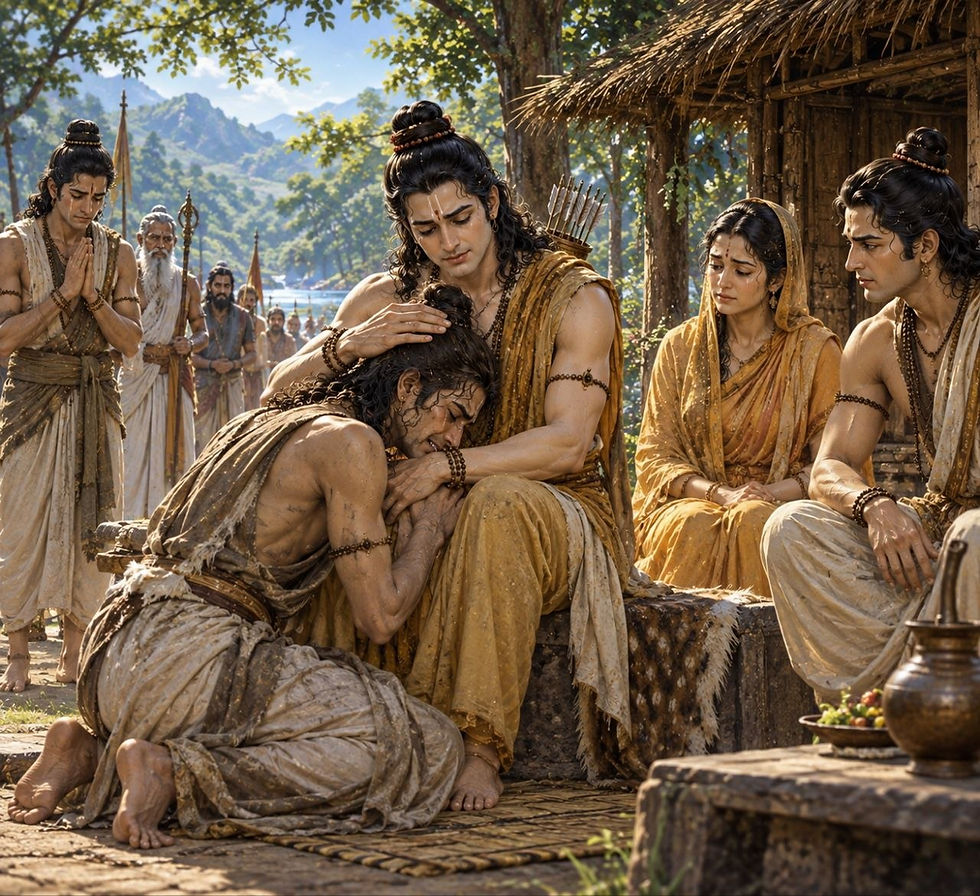
While the righteous Rama was thus consoling Bharata, the revered Brahmin sage Jabali began to speak words that appeared to contradict the principles of Vedic dharma.
“O Raghava! You possess exceptional wisdom and a thoughtful mind. Do not follow this futile line of reasoning like an ordinary man. Who is related to whom? What does one person truly owe another? In this world, there is no real bond between one individual and another. Everyone is born alone and dies alone.
“Therefore, whoever becomes attached to others, thinking, ‘He is my father,’ ‘She is my mother,’ ‘He is my son,’ or ‘She is my daughter,’ is surely a fool. For no one truly belongs to anyone, and no lasting relationship exists between one person and another.
“When a child is conceived, the man who is called the father merely provides the seed. When the seed, in the form of semen, unites with the blood within the womb of a woman who has reached maturity, conception takes place, and a human being is born. Your father has gone to the very place to which all beings must eventually depart. Birth and death, engagement in worldly life and withdrawal from it, are common to all living creatures. Yet, despite this truth, you are grieving by imagining relationships that are ultimately unreal.
“I feel pity for those who toil to acquire wealth and pursue dharma. Those who earn wealth for the sake of righteousness have no time to concern themselves with the enjoyment of worldly pleasures. They endure suffering in this world to attain wealth and fulfil their religious duties, only to perish after death.
“O man of great wisdom! Make your mind firm in the conviction that there is no world beyond this one. Embrace the happiness that is directly available to you. Reject what is beyond perception, and do not place your faith in it.
“Accept the kingdom of Kosala from Bharata, who is honoured by all, and rule as its sovereign. This course is acceptable to everyone, for direct perception alone is the true means of knowledge, and it is the wisdom of sensible men that deserves recognition.”
Rama, the foremost among those who upheld truth, listened to Jabali’s words. Yet his mind remained entirely unshaken. Taking refuge in the noble teachings sanctioned by the Vedas, he replied:
“O revered sages! The counsel you have offered, wishing to bring me happiness, may appear reasonable and practical on the surface. But to act upon it would be wrong.
“Just as people fear a serpent when they see one, they also fear a person who speaks falsehood. Truth is the highest dharma in this world, and it is firmly established as the very foundation of attaining heaven.
“In the presence of my father, I made a solemn vow. When I made that promise, Queen Kaikeyi was greatly pleased. Shall I now break that vow, which fulfils my obligation to my father and brings happiness to my mother?
“No. I shall continue to dwell in the forest, living a pure life and consuming food in moderation. With auspicious roots, fruits, and flowers, I shall worship the gods and offer reverence to my ancestors.
“With my five senses kept under control and my mind content, I shall carefully distinguish between what ought to be done and what ought not to be done. With faith and sincerity, free from deceit, I shall fulfil my father’s command and continue my life in accordance with dharma.
“Having been born in Bharata Khanda, this land where human beings are called upon to perform their deeds, one must undertake actions that lead to auspicious results. Agni, Vayu, and Chandra have attained their exalted positions through the fruits of their respective deeds.
“Therefore, it is not true that actions bear no consequences, as you have suggested. Only after performing a hundred sacrifices did Indra attain the position of king of the gods and ascend to heaven. Likewise, the great sages attained heaven through the performance of intense austerities.”
Thus Rama, the great-souled prince, spoke sternly, his heart inflamed with righteous indignation. Seeing his resolute stand, Jabali addressed him once again with gentle, respectful, and truthful words, in harmony with the path of the Vedas:
“Rama! It is not my nature to speak like an atheist at all times. I am neither an atheist nor one who declares that there is no world beyond this life. Having heard your words, I have now become a believer. When the occasion demands, I may speak as an atheist once again.
“The time had come for me to present an atheistic argument before you, and therefore I did so. I, too, felt that you ought to return to Ayodhya, just as Bharata desires. Wishing to persuade you to return and to bring comfort to Bharata, I presented these arguments before you.”


Comments