


Vidura’s Wisdom: Unveiling the Conspiracy ( Mahabharata Series 52)

The wicked Purochana readily agreed to Duryodhana’s proposal. He immediately set out for Varanavata in a chariot drawn by swift horses. Following Duryodhana’s instructions, he began making preparations for the construction of the Palace of Lac.
Meanwhile, the Pandavas prepared to depart for Varanavata. Before setting out, they bowed respectfully at the feet of the elders who had gathered around them. Seated in a chariot drawn by magnificent horses, the sons of Pandu began their journey.
The sorrowful citizens followed the Pandavas for some distance, unable to bear the thought of their departure. Some, overcome by grief and anger, openly criticised Dhritarashtra for sending the Pandavas away. They praised the virtues of the sons of Pandu and lamented the injustice being done to them.
Seeing the people following their chariot with such affection and sorrow, Yudhishthira gently consoled them. He requested everyone to return to their respective homes and not accompany them any further. Respecting his words, the citizens circumambulated the Pandavas’ chariot, offered their heartfelt blessings, and reluctantly returned home.
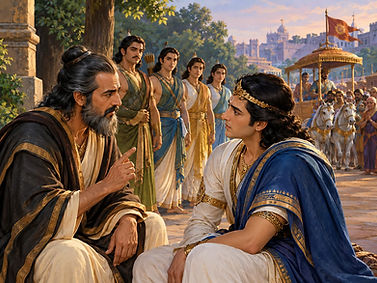
At last, only Vidura remained.
He had no intention of accompanying the Pandavas on their journey. Instead, he wished to remain behind and offer Yudhishthira some words of wisdom. He also desired that their conversation should remain a secret, beyond the understanding of anyone else.
Vidura, who was wise and capable of understanding the deeper meaning of the speech of the learned, addressed Yudhishthira, who was equally discerning and could comprehend such subtle expressions.
"प्राज्ञः प्राज्ञ प्रलापज्ञः प्रलापज्ञमिदं वचः।
प्राज्ञं प्राज्ञः प्रलापज्ञः प्रलापज्ञं वचोब्रवीत्॥"
Meaning: The wise Vidura, who understood the hidden meaning of the speech of the learned, spoke these words to the wise Yudhishthira, who was also capable of understanding such subtle expressions.
The expression "Prajna Pralapa" would ordinarily mean the speech of the learned. However, according to certain traditional commentators, the expression is interpreted by dividing it as "Pra-karsena Ajnah", meaning one who is exceedingly ignorant.
Here, the reference is to people who did not understand the meaning of the Vedas and to those who spoke the Mleccha language. Vidura and Yudhishthira were both familiar with this language. Thus, they could converse in a manner that remained incomprehensible to those around them, ensuring that their exchange of words remained completely confidential.
Vidura then continued:
"यो जानाति परप्रज्ञां नीति शास्त्रानुसारिणीम्।
विज्ञायैह तथा कुर्यादापदं निस्तरेद्यथा॥"
Meaning: "O Yudhishthira! One must understand the thoughts and intentions that arise in the minds of one's enemies, particularly those who act according to the principles of political strategy. One must discern the methods by which they intend to put their plans into action. Only after understanding their designs can one decide how to act and escape the dangers that may arise."
The political principles explained by Kanika were known to Dhritarashtra, and Yudhishthira too was well aware of them. The same principles of statecraft could be employed both to destroy one's enemies and to protect oneself from their schemes. While one person might use political strategy to eliminate an opponent, another could use that very knowledge to defend himself.
For instance, a village guard who wishes to catch thieves must understand the methods employed by thieves. Only by knowing how theft is committed can he identify and prevent it.
Yudhishthira understood these principles well. However, what he needed to determine was whether Dhritarashtra's decision to send the Pandavas to Varanavata was merely an ordinary act or a carefully planned political manoeuvre.
If Dhritarashtra had indeed sent them away as part of a calculated strategy to eliminate them, Yudhishthira was capable of recognising the danger and finding a way to overcome it.
It was with this understanding that Vidura offered his warning. He was indirectly revealing that Dhritarashtra might be employing the principles of statecraft to destroy his supposed enemies. Anyone who could recognise the intentions and strategies of an enemy, Vidura advised, would be able to find a way out of impending danger.
Vidura continued:
"अलोहं निशितं शस्त्रं शरीरपरिकर्तनम्।
यो वेत्ति न तं घ्नन्ति प्रतिघातविदो द्विषः॥"
Meaning: "There are weapons that are not made of iron, yet they are sharp and capable of destroying the human body. One who knows of such weapons and understands how to counter them cannot easily be destroyed by enemies who employ such methods."
Vidura was referring to weapons other than those made of iron. Such weapons could cause destruction just as effectively as ordinary weapons, even though they were not made of metal. A person who recognised these hidden dangers and knew how to protect himself could escape them.
The weapons Vidura alluded to were fire and poison.
According to the traditional commentators, this verse contains words drawn from the Mleccha language and is specifically connected with the Palace of Lac. The words in the verse are therefore interpreted by dividing them in a particular manner:
"अलोहं-निशि-तं-शस्त्रं-शरीरपरि-कर्तनम्"
The commentators explain that the word "Aloham" belongs to the Mleccha language. According to their interpretation, "Ala" means fire, with the initial 'na' omitted from the Sanskrit word "Anala", which means fire.
Similarly, the Sanskrit word "Sastra" is used in the sense of a house or dwelling in certain traditional interpretations. In the Mleccha language, the consonant 'sa' is pronounced as 'sha'. Thus, the word "Shastram" is interpreted to mean a house.
Through this coded expression, Vidura was conveying a grave warning to Yudhishthira: the danger awaiting the Pandavas at Varanavata was not merely from ordinary weapons. Fire itself could become the instrument of their destruction.
Vidura's words were brief, but their meaning was profound. He had revealed the hidden danger without openly accusing anyone. Yudhishthira, being intelligent and perceptive, was expected to understand the warning and remain vigilant against the treacherous designs awaiting them at Varanavata.


Comments