


The Conspiracy to Send the Pandavas to Varanavata (Mahabharata Series 50)

The Conspiracy to Send the Pandavas to Varanavata (Mahabharata Series 50)
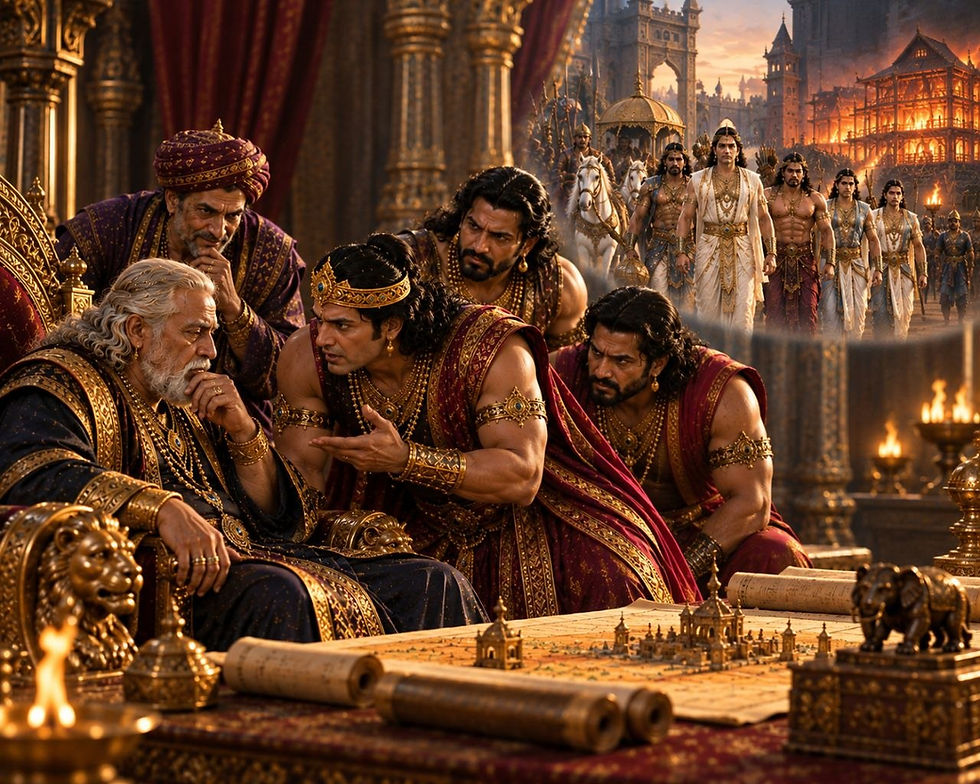
Yudhishthira, who had been appointed Crown Prince, was constantly engaged in addressing the grievances and difficulties of the people. Through his dedication to their welfare, he won their affection and respect. The citizens admired the Pandavas, who were endowed with every noble virtue, and spoke highly of their character and accomplishments.
The people of Hastinapura began to express their views openly:
“Dhritarashtra, who was born blind, is not qualified to continue as our king. It was because of his physical disability that he was denied the right to ascend the throne. After the death of our beloved King Pandu, Dhritarashtra assumed the kingship only temporarily. Now, Yudhishthira, the eldest son of Pandu and the Crown Prince, is in every way worthy of ruling the Kuru Empire. Let us unite and enthrone Yudhishthira as our king. Such a decision would bring prosperity and well-being to everyone.”
At first, Duryodhana heard these opinions from others. Before long, however, people began expressing such sentiments openly in his presence.
Already consumed by jealousy toward the Pandavas, Duryodhana was inflamed with resentment upon hearing these words. Although Bhishma and Vidura had not yet reached any decision regarding the coronation of Yudhishthira, Duryodhana could not tolerate the citizens’ growing desire to see him on the throne.
Burning with jealousy, he went to his father, Dhritarashtra, determined to persuade him to take action.
Finding his father alone, Duryodhana addressed him:
“Father, of late, our people have begun to show disrespect toward you and Bhishma. They wish to make Yudhishthira their king. Bhishma, who has no desire to assume the responsibilities of ruling the kingdom, may even support their proposal.
“This movement among the people is causing me immense distress. As the elder brother, you should have inherited the throne. But because of your physical disability, you were denied that right, and Pandu ascended the throne instead.
“If Pandu’s son now succeeds him, the throne will remain exclusively in the line of Pandu, and the sons of Dhritarashtra will never have the opportunity to rule. Today it will be Yudhishthira, tomorrow his son, and thereafter his grandson. This succession will continue indefinitely, while we and our children will be permanently excluded from the royal lineage.
“We shall become insignificant in this world. No one will even regard us as princes. To lose our honour and dignity and be forced to depend on others merely for our food would be no better than living in hell.
“Father, you must adopt some strategy to prevent this misfortune from overtaking us. Had you yourself assumed the responsibility of ruling the kingdom and become the emperor, we, your sons, would naturally have inherited the throne. We would not have needed to concern ourselves with the opposition of the people.”
Dhritarashtra, whose inner vision was clouded by conflicting thoughts despite his blindness, listened to every word spoken by his son.
Kanika’s teachings on political strategy began to echo in his mind. Unable to arrive at an immediate decision, he remained deeply troubled.
Duryodhana, however, had already discussed the matter with Karna, Shakuni, and Duhshasana and had determined what he intended to propose.
He said to his father:
“Father, find some pretext and send the Pandavas to Varanavata immediately. Once they have gone there, we shall no longer have anything to fear from them.”
Dhritarashtra reflected for a moment and then sighed deeply before replying to his son.
“My child, my younger brother Pandu was a noble man who always showed me extraordinary affection and respect. His son, too, possesses every virtue and has won the love of the people. Because of Yudhishthira’s exceptional qualities, many kings have already become his allies.
“How can we forcibly exile the Pandavas now?
“The ministers, commanders, other officials, their families, and the soldiers were all cared for by Pandu as though they were his own children. The affection they once held for Pandu has now extended to Yudhishthira.
“If we attempt to harm the Pandavas under these circumstances, will all these people remain silent? I fear they may turn against us and bring about our own destruction.”
Duryodhana replied confidently:
“Father, I have already considered all these factors. I have been generously rewarding our servants, officials, and ministers with wealth and gifts. Through these means, I have already drawn many among the officials to our side.
“If we continue distributing wealth on a vast scale, the people too may gradually come to believe that we are capable and worthy rulers.
“Therefore, you must devise a plausible pretext and send the Pandavas to Varanavata without delay. Once the empire has come firmly under our control, they may return to Hastinapura.”
Thus, Duryodhana attempted to convince Dhritarashtra that the removal of the Pandavas from Hastinapura was essential to securing the throne for himself and his descendants. Beneath his seemingly practical arguments lay an ambition driven by jealousy, fear, and an unwillingness to accept the growing popularity of his cousins.
The seeds of a dangerous conspiracy were beginning to take root in the Kuru court.


Comments