


SHAKUNI

SHAKUNI
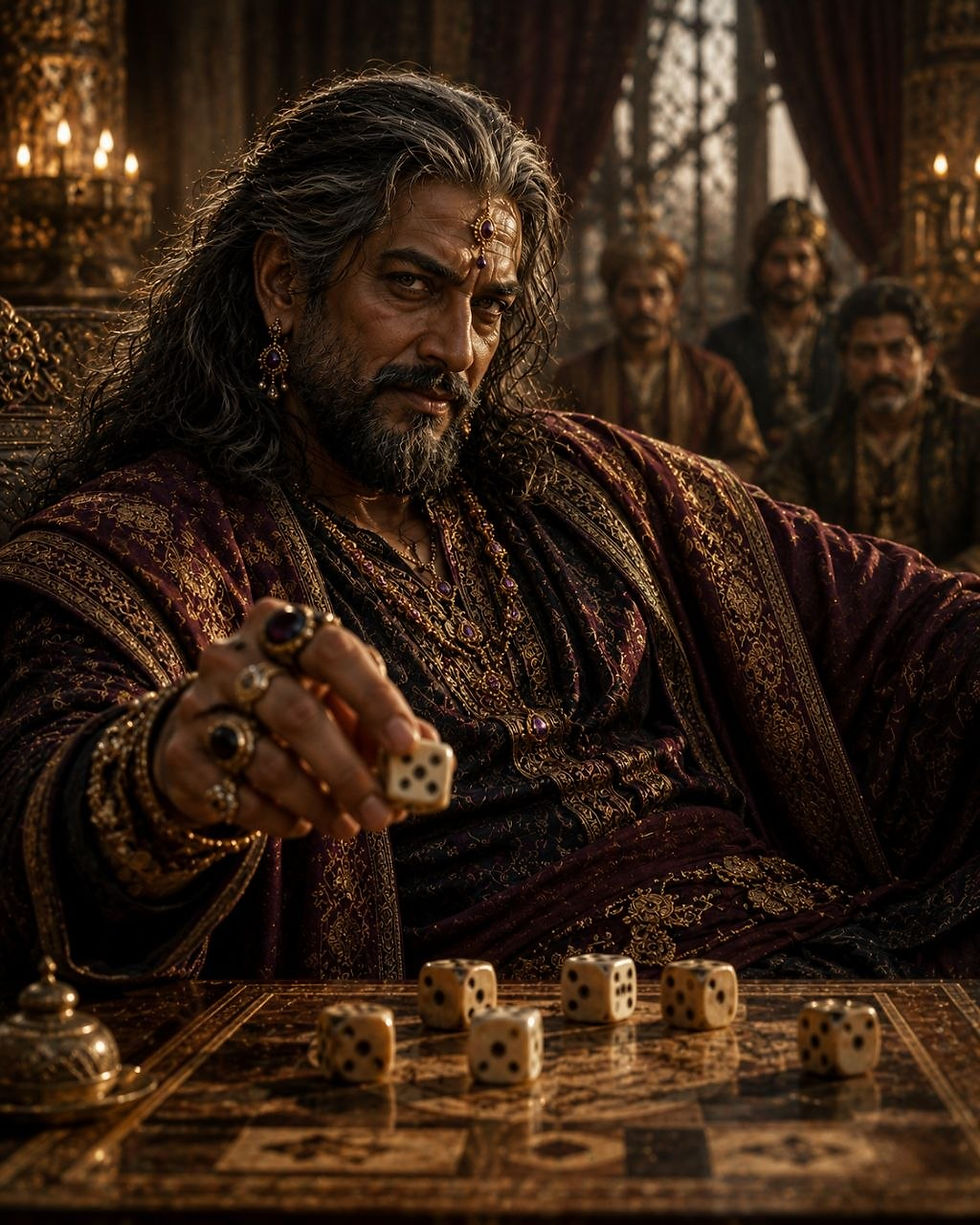
**I am Shakuni...**
A prince of Gandhara.
I had a kingdom to serve, a father to obey, and responsibilities to uphold. Yet above all these stood one person—my sister.
I loved her beyond measure.
She possessed every virtue a woman could have: beauty, grace, intelligence, and nobility. My greatest wish was to see her married to a worthy warrior, a man who could cherish and protect her.
But my father feared Bhishma.
The mighty guardian of Hastinapura. A warrior of unmatched prowess—and, in my eyes, a master of political coercion.
Caught in the currents of royal diplomacy, my father became helpless. He agreed to give his beloved daughter in marriage to a blind prince.
My poor sister.
Bound by duty, Gandhari accepted her father's decision. She married Dhritarashtra, the blind heir of the Kuru dynasty.
Had it ended there, perhaps I might have remained silent.
But Gandhari did something that shattered my heart.
She blindfolded herself.
Her husband could not see the world, and she chose not to see it either. She willingly embraced darkness.
Even then, my father could have refused. He could have declared, "Let my life be taken, but I shall not give my daughter to a blind man."
But he did not.
The marriage took place.
And my beloved sister left Gandhara forever.
I could not bear it.
What was left for me in Gandhara anyway? Gambling? If I wished to gamble, I could do that anywhere. So I chose to accompany my sister—to stand beside her, to be her support in a strange land.
My brother-in-law was blind.
My sister had chosen blindness.
What kind of future awaited them?
And for some reason, I could never trust Bhishma.
Had he truly been a righteous man, would he have given a woman as beautiful and accomplished as Gandhari to a man incapable even of seeing her face? Had she been his own daughter, would he have arranged such a marriage?
Was this the justice of a great warrior?
To use power and influence to cast a woman's life into darkness?
The more I thought about it, the more my anger grew.
And then I learned that Bhishma had sworn to protect Hastinapura and the Kuru dynasty with his life.
Very well.
Then it would be that dynasty that would fall.
The family that had wronged my sister deserved no better.
As they had pushed Gandhari's life into darkness, so too would darkness consume their lineage.
In my anger, I made that decision.
And I followed my sister to Hastinapura—not merely as her companion, but as her eyes in a world she had chosen not to see.
Let people think what they will.
My sister's happiness was all that mattered to me.
In ages to come, storytellers would weave legends about me. They would say I was imprisoned. They would claim I was starved and humiliated. They would create tales of vengeance and cruelty.
But is it not noble for a brother to stand beside his sister?
Why does the world fail to understand the love between siblings?
I arrived in Hastinapura.
It was a magnificent city.
Yet I knew no one there except Gandhari. And she, too, was a stranger in that place.
The people welcomed us warmly. There was celebration everywhere.
Naturally.
A royal wedding had taken place.
And amidst all that celebration, I first noticed him.
Pandu.
Dhritarashtra's younger brother.
The king.
Why was the younger brother crowned while the elder remained uncrowned?
Was blindness enough to deny a man his birthright?
From that very moment, I understood.
An injustice had been done to Dhritarashtra.
And now that I was here, I would ensure that no further injustice touched him.
That became my resolve.
Pandu married twice—Kunti and Madri.
Yet fate mocked him. A curse deprived him of the very joys of married life. Broken and defeated, he retreated to the forest.
With no opposition remaining, Dhritarashtra finally ascended the throne.
Then came another challenge.
Pandu's children were born.
Gandhari was distressed.
A natural feeling for a woman.
She too was carrying a child, yet the birth seemed endlessly delayed.
Eventually, through the intervention of a sage, her offspring were born.
Not one child.
Not ten.
One hundred and one children.
Children destined, in my eyes, to challenge the sons of Pandu.
I loved them all.
But Duryodhana...
Duryodhana held a special place in my heart.
Everything I did was for his welfare.
Dhritarashtra rarely listened to Vidura's counsel anymore. But he trusted me completely.
Other than his fear of Bhishma, he was a good man.
And whenever Gandhari's children called me *"Mamashri"*—revered uncle—my heart overflowed with affection.
I loved them even more than my own son, Uluka.
I taught them the game of dice.
When the Pandavas returned to the palace after losing their father, I sought ways to drive them away. I even attempted to eliminate Bhima with poison.
Why?
Not for personal gain.
Not for ambition.
Only for the sake of my nephews.
Then came Draupadi.
Even then, I looked upon the Pandavas with disdain.
What fools they were!
Five brothers marrying one woman.
Let them live however they pleased.
But the kingdom belonged to my nephews.
Not only that—even the prosperous realm the Pandavas built should ultimately belong to them.
Defeating the Pandavas in open battle would not be easy. They had Krishna beside them.
Krishna—the clever strategist.
So I chose another battlefield.
Dice.
The game I had mastered since childhood.

What else had I truly learned besides gambling?
Was it any surprise that the dice obeyed my will?
And so the Pandavas were defeated.
Humiliated.
Exiled.
What was wrong with that?
Is it a crime to secure the future of one's own family?
Whether during their exile or their incognito years, I constantly sought opportunities to destroy them. Time and again, they escaped.
Even the House of Lac failed to consume them.
How frustrating!
But my purpose never changed.
My nephews must not be deprived of what was theirs.
Should not the eldest son's eldest son inherit the throne?
Then by what logic did Bhishma, Krishna, and the others claim that injustice was being done to the Pandavas?
Fools.
All of them.
Despite every obstacle, the Pandavas returned.
Perhaps the saying "the wicked live long" was invented for them.
At last, we accepted the inevitable.
War.
Duryodhana's army dwarfed theirs. Mighty warriors stood with us. Why should we fear?
Even when Krishna came as a messenger of peace, I supported insulting him.
Was that wrong?
He always stood with the Pandavas.
Could he not see justice on my nephews' side?
Then came the great war.
My son and I entered the battlefield.
Day after day, the slaughter continued.
On the seventeenth day, exhaustion overwhelmed me. For the first time, I felt that perhaps enough blood had been spilled.
And then...
Nakula's spear found its mark.
That was the end.
Tell me now—
Where was my selfishness?
I stood by my nephews.
I fought for them.
I sacrificed everything for them.
I never sought power for my own son.
I never asked for a kingdom.
I never demanded a throne.
I was, in my own eyes, the ideal uncle.
So why does history remember me as a schemer?
Why does the world call Shakuni deceitful?
I am Shakuni.
Judge me if you must.
But first, try looking at the world through the eyes of a brother who loved his sister—and through the heart of an uncle who loved his nephews more than himself.


Comments