


Kausalya’s Grief and Lakshmana’s Fiery Counsel (Ramayana Series 26)

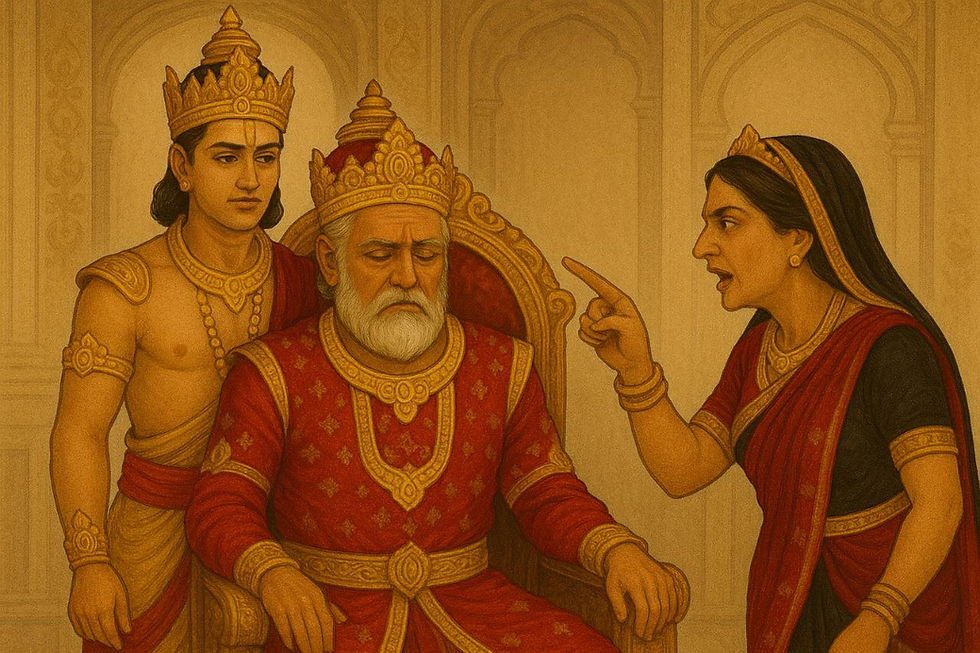
As Queen Kausalya wept endlessly, remembering the impending separation from her beloved son, Lakshmana—his heart burning with anguish—spoke in a voice filled with indignation:
“Mother! It does not seem right to me that noble Rama should submit to the words of a scheming woman and abandon the kingdom, choosing exile in the forest. If someone claims ‘Rama is obeying the king’s command,’ even that command is unfit to be followed now. For the king has become confused in mind—aged, blinded by desire, childlike in judgment, bereft of discernment. What prince trained in the principles of kingship would accept such irrational words?
Before the news of this exile spreads, let us secure the throne. With my support, brother, you can ascend the kingdom and uphold righteous rule. And if anyone—driven by Kaikeyi—dares to oppose you, do not fear. Armed with my bow, I will stand beside you like Yama himself. Who can challenge you then?
If all of Ayodhya rises against us on behalf of Bharata, I shall reduce this city to emptiness with my arrows. Softness has no value—‘the gentle are always overpowered.’ If our father, misled by Kaikeyi, insists on crowning Bharata and turns hostile towards us, then let us imprison him—or even put an end to him. A man who has lost judgment, who refuses the path of the wise—though he be a guru—is deserving of punishment.”

Hearing Lakshmana’s fierce words, grief-stricken Kausalya cried out:
“My son! You have heard what your loving brother has said. Now do what you feel is right. But it is not proper for you to leave me—suffering under my co-wife’s unrighteous plots—and go to the forest.
If you are truly a knower of dharma, then remain here and serve your mother. Motherly service is a supreme duty. Just as the king is worthy of your reverence, so am I. A father’s command must be obeyed, yes—but I do not permit you to leave for the forest.”
Rama, the embodiment of righteousness, gently replied:
“Mother, I do not possess the strength to disobey my father’s command. I bow to you—please be gracious. Even the sage Kaṇḍu, though fully aware that cow-slaughter was sinful, performed it to fulfil his father’s word. The righteous Paraśurāma obeyed his father Jamadagni and struck down his own mother Reṇukā in the forest. Many divine-like men have upheld their father’s word.
I too must perform the duty worthy of a noble son—what is pleasing to my father. I am not the first, nor the only one, to follow the path of filial obedience. No one who honours the command of his father has ever fallen into misfortune—nor shall I.”
Comments