


Ekalavya’s Guru Devotion and the Princes’ Test (Mahabharata Series 38)
Ekalavya’s Guru Devotion and the Princes’ Test
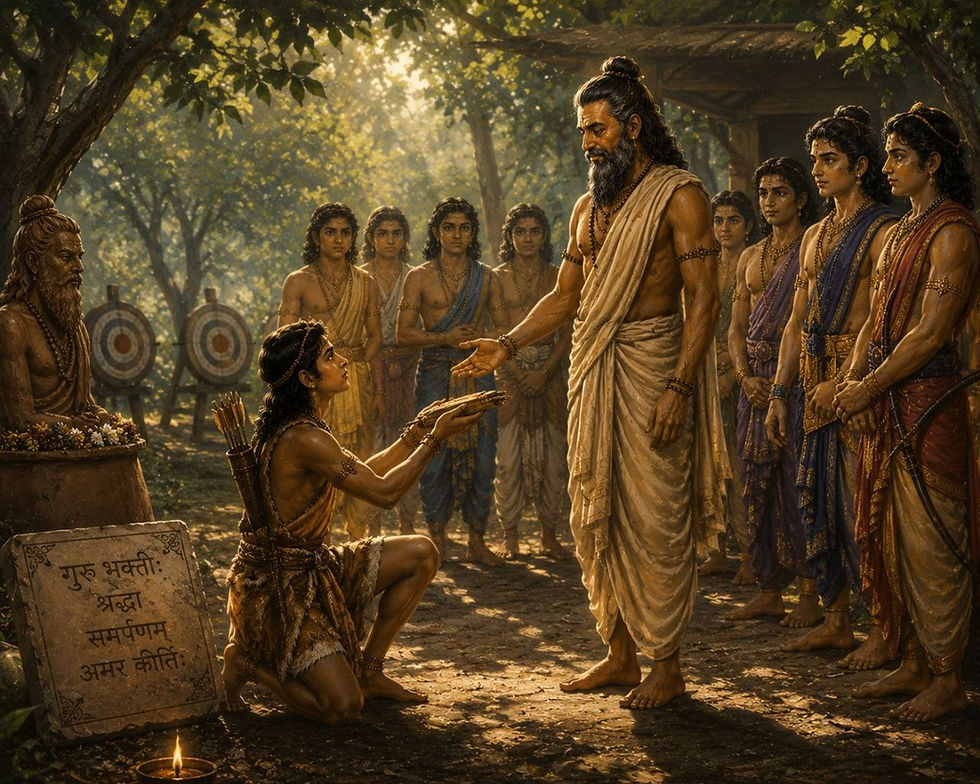
When Drona asked Ekalavya for a guru dakshina (teacher’s offering), the Nishada prince was overjoyed. With folded hands and unwavering devotion, he replied:
“Revered Master, command me. What shall I offer? There is nothing that I would withhold from my guru.”
Drona then made a startling request:
“If that is so, give me the thumb of your right hand as your guru dakshina.”
Even upon hearing this severe demand, Ekalavya did not waver. Firm in his devotion and commitment to truth, he remained calm and cheerful. Without hesitation, he drew his sword, severed the thumb of his right hand, and placed it reverently before his guru.
Through this extraordinary act of sacrifice, Ekalavya earned an immortal place in history as the very embodiment of guru bhakti—absolute devotion to one’s teacher. His fame endured through the ages, and he became forever remembered as one of Drona’s most devoted disciples.
Though he continued practicing archery even without his thumb, he could never regain the same speed, precision, and mastery he had once possessed. Arjuna, who had feared the possibility of being surpassed, felt reassured. Drona’s promise that no archer would exceed Arjuna’s skill ultimately came true.
Meanwhile, the other princes also excelled in their chosen disciplines. Bhima and Duryodhana became masters of mace combat, though their rivalry grew stronger with every passing day. Ashwatthama attained great proficiency in celestial weapons. Nakula and Sahadeva became experts in swordsmanship. Yudhishthira distinguished himself among chariot warriors and earned renown for his leadership and composure.
Among all the students, however, Arjuna stood apart. His intelligence, concentration, strength, enthusiasm, dedication to practice, and devotion to his guru made him exceptional. Although Drona taught all his disciples equally, Arjuna’s relentless discipline elevated him above the rest.
He eventually attained the rank of an Atiratha—a warrior capable of confronting tens of thousands of enemies simultaneously. Among Drona’s many students, Arjuna alone achieved this distinction. His unwavering dedication to learning and deep reverence for his teacher became the foundation of his greatness. Consequently, the fame of Partha spread throughout the land.
Bhima, on the other hand, became renowned for his immense physical strength. Observing the remarkable growth of Bhima and Arjuna, Duryodhana and his brothers became increasingly jealous.
Drona’s Test of Concentration
Having completed the training of the Kuru princes in various branches of warfare, Drona decided to test their skill and focus.
He instructed artisans to place an artificial bird high upon a tree. Gathering all the princes, he pointed toward the bird and said:
“Princes, your task is to strike this bird. When I call each of you forward, you must aim carefully and sever its head with a single arrow.”
The princes, having trained for many years, considered the challenge quite simple and eagerly awaited their turns.
Drona first summoned Yudhishthira, the eldest among them.
Yudhishthira fitted an arrow to his bow and took aim at the bird.
Drona asked:
“Yudhishthira, do you see the bird on the tree?”
“Yes, revered teacher,” replied Yudhishthira. “I see the bird.”
Drona continued:
“What else do you see? Do you see me as well?”
“Yes, Master, I see you too.”
“Do you also see your brothers standing nearby?”
“Yes, Guru. I see them as well.”
Hearing this answer, Drona was disappointed. He immediately stopped the test and said:
“Step aside, Yudhishthira. You will not be able to strike the target.”
The great teacher was searching not merely for skill, but for absolute concentration—a mind fixed solely upon the target. Yudhishthira’s attention was still divided, and thus he failed the first stage of Drona’s famous examination.


Comments